
While thousands of climbers have successfully been at the very top of Mount Everest, the highest point on Earth, only three people have descended to the planet’s deepest point, the Mariana Trench in the Pacific Ocean. Getting down there at the Trench is not only an adventurous milestone but it also stands as one of the most unfavourable places on the Earth.
The Mariana Trench is located in the Pacific Ocean, just east of the 14 Mariana Islands near Japan. As one would probably know by now, it is the deepest part of the earth. This deepest location of the earth was created by ocean plate-to-ocean plate subduction, a phenomenon in which a plate topped by oceanic crust is subducted beneath another plate topped by oceanic crust.
The deepest part of the Mariana Trench is the Challenger Deep named after the exploratory vessel HMS Challenger II, a fishing boat that was converted into a sea lab by Swiss scientist Jacques Piccard is approximately located 210 miles south-west of Guam. To better put forth the exact depth of the Trench, consider the following - if Mt Everest, which is the tallest point on earth at 8,848 meters was set in the Mariana Trench, there would still be 2,146 meters of water left over it.
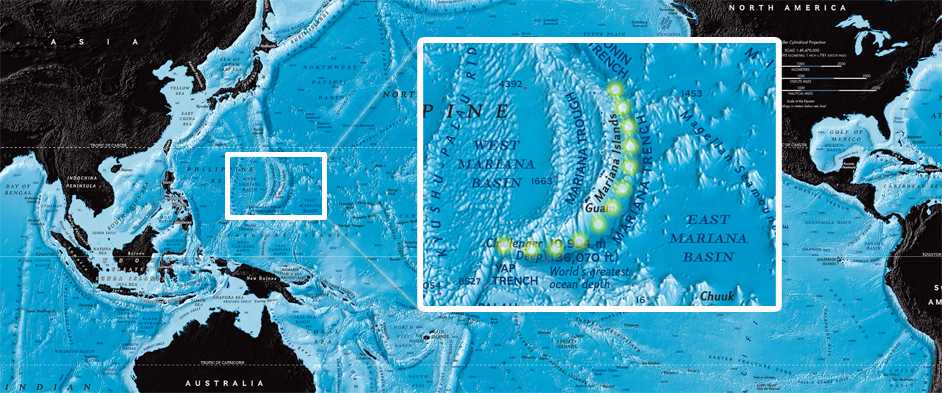
Because of its extreme depth, the Mariana Trench is cloaked in perpetual darkness and the temperature is about 1 to 4 degrees Celsius. pressure at the bottom of the trench is eight tons per square inch or about a thousand times the standard atmospheric pressure at sea level equivalent to the pressure of 50 jumbo jets on a normal human. The science here clearly states that it is almost impossible to find any life forms down here.
The water This depth of the Mariana Trench was first made possible in 1960 by the Trieste, a manned submersible owned by the U.S Navy. The historic people behind the Trieste's wheel were Swiss scientist Jacques Piccard & US Navy Lt. Donald Walsh. The Trieste was designed by Jacques Piccard's father Auguste that set a record by diving to a depth of 10,900 meters. The Challenger expedition gave us our first glimpse of deep ocean basins and other main characteristics of the ocean floor.
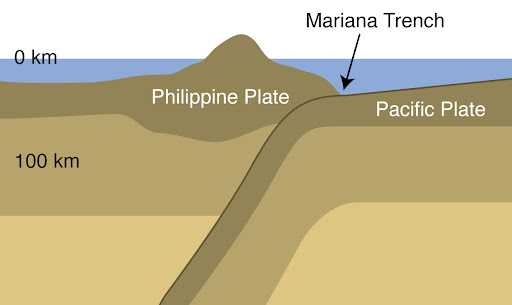
In addition to exploring the Mariana Trench, the Challenger gathered important data on the features and species of the Pacific, Atlantic, and Indian oceans, covering nearly 130,000 kilometres. Nearly 5000 new species of sea creatures were discovered during the 4-year expedition. In March of 1995, the Japanese submarine Kaiko was used to conduct further research deep within the Mariana Trench. The Kaiko was a sophisticated vessel with a highly accurate positioning system, allowing scientists to gather important data without the need to endanger a human diver and the Japanese were spot on with the task they took up.
Best known as a Hollywood director and now a National Geographic Society explorer in residence, James Cameron is one of just three people to dive to Earth's deepest point, and the only one to be able to stay long enough to look around. Despite Cameron's record dive, it's impossible to know what really happens in the subduction zone, since most of the action occurs at 700 kilometres below Earth's surface. Even so, with subsequent dives, there's the prospect of retrieving rock samples and looking for life deeper than it's ever been found before. Cameron's trip was more of a man-on-the-moon thing to many. The Mariana Trench's microscopic inhabitants might even shed light on the emergence of life on Earth. Some researchers, such as Patricia Fryer, University of Hawaii, have speculated that serpentine mud volcanoes located near ocean trenches might have provided the right conditions for our planet's first life forms. Additionally, studying rocks from ocean trenches could lead to a better understanding of the earthquakes that create the powerful and devastating tsunamis seen around the Pacific Rim.
From these two different expeditions carried out, there has been a huge controversy over whether life could possibly exist at the bottom of the trench. Piccard was stern on what he saw was a giant creature which would have been a huge find challenging the concept of favourable conditions for life to enhance, but later on, these thoughts were later turned down saying that what he saw was just a formation called Sea Cucumber.
As of now the majority of the Mariana Trench is now a U.S. protected zone as part of the Mariana Trench Marine National Monument, and hence it's getting tougher and tougher to conduct researches at this place. Even though we've known about the Mariana Trench for a long time now, there's a lot more it has in store for us but for now, it still remains the place where lies the Earth's deepest secrets.
Bibliography
- National Geographic. 2014. http://www.deepseachallenge.com/the- expedition/mariana-trench/ (accessed on 5th December 2014)
- www.marianatrench.com. 2014. http://www.marianatrench.com/ (accessed on 5th December 2014)
- Image 1: http://i2.cdn.turner.com/cnn/dam/assets/120228085332-mariana-trench- diagram-story-top.jpg (accessed on 5th December 2014)
- Image 2: http://worldbeneaththewaves.com/. http://worldbeneaththewaves.com/wp/wp- content/uploads/2012/07/WBTW-125-Marianas-Trench-125-copy2.jpg (accessed on 5th December 2014)
- Cover Image: https://www.americanoceans.org/wp-content/uploads/2021/06/Mariana-trench.jpg (accessed on 5th December 2014)


